Social Anxiety and Mental Loops: How to Stop Overthinking Every Interaction
Updated: Jul 31
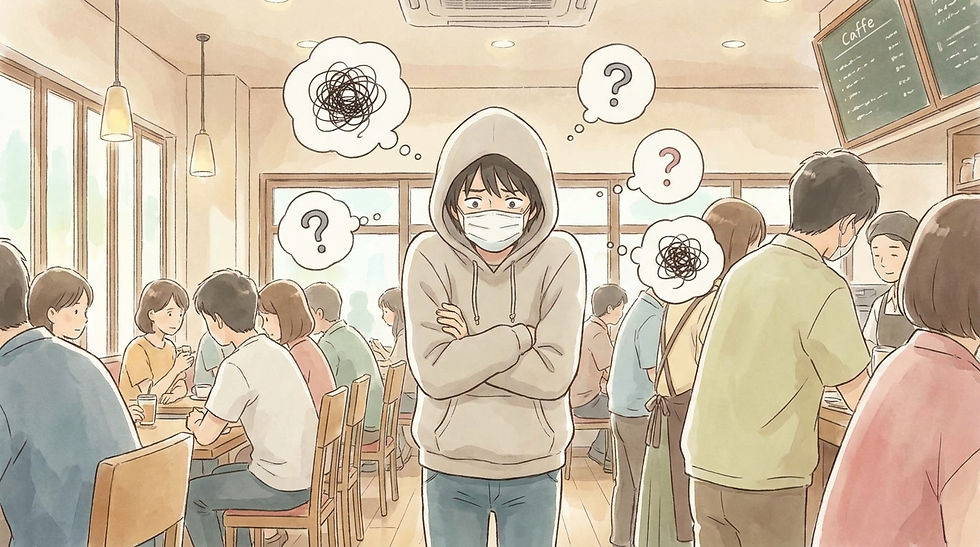
When Social Life Feels Like a Replay Button
You leave a conversation and immediately your mind starts working overtime:“Did I sound weird? Did I talk too much? Did I say something wrong?”
If you find yourself replaying conversations, overanalyzing every look and pause, or avoiding social situations because of this mental loop, you are not alone. Social anxiety is one of the most common anxiety challenges worldwide, affecting an estimated 7% or more of people in any given year and up to about 12% across a lifetime. Many more people experience milder but still painful social worries and overthinking, especially in group settings, at work, or online.[1][2][3][4][5]
Social anxiety is a pattern of intense worry about being judged, embarrassed, or rejected in social or performance situations. It is not just shyness. It can show up as:[2][5]
The good news: social anxiety and the mental loops that come with it are understandable, common, and changeable.
How Social Anxiety, Rumination, and Overthinking Connect
Rumination: “Stuck in the aftermath”
After a social situation, many people with social anxiety go into “mental review mode”:
“Why did I say that?”
“I sounded so awkward.”
“They probably think I’m boring / strange / stupid.”
Researchers call this post‑event rumination – repeatedly going over what happened and focusing on how badly you think you performed. This style of thinking tends to:[7]
Overthinking and mental loops
Social anxiety also fuels overthinking before and during events:
Experts describe this as a social anxiety spiral: anxious predictions → tense performance → harsh self‑evaluation → rumination → more anxiety next time.[4][7]
The impact – but keeping it realistic
Social anxiety and rumination can:
At the same time, not everyone with social anxiety is “broken” or unable to function. Many people work, study, have friends, and show up in life while quietly managing these mental loops. The goal is not to pathologize normal nerves, but to give you practical tools so social life feels less like a constant, exhausting test.[5][2]
Practical Tips to Ease Social Anxiety and Reduce Rumination
These tools are based on research and clinical guidance, but explained in everyday language. You can test them, keep what works, and leave the rest.
Tip 1: Name the Pattern – “This Is Post‑Event Rumination”
Next time you catch yourself replaying a conversation:
Say: “This is post‑event rumination – my brain is reviewing on a loop.”
Remind yourself: “Rumination is a habit, not a requirement.”
The National Social Anxiety Center notes that simply recognizing this habit helps you pause and choose a different response instead of sliding deeper into the loop. You are not your thoughts; you are the person noticing them.[7]
Tip 2: Do a Balanced “3–2–1 Review” (Then Stop)
After a social situation:
Write down:
3 things that went okay or well (even small ones: “I showed up”; “I listened”; “I smiled at someone”).
2 things you might do differently next time (concrete, not self‑attacks).
1 takeaway you want to remember.
Then say: “Review done – I’m not going to keep rerunning this.”
Experts emphasize testing beliefs (“What’s the actual evidence I was a disaster?”) and adjusting unrealistic expectations. This exercise helps your brain learn from experience without staying stuck in self‑criticism.[6][7]
Tip 3: Shift Attention Outward in the Moment
In social anxiety, attention turns inward (“How am I coming across?”), which usually increases anxiety and awkwardness.[3][6]
To break this:
Gently shift focus outward during conversations:
Notice what the other person is saying and feeling.
Look for details in the environment (colors, sounds, objects).
Ask simple, curious questions instead of monitoring yourself.
Harvard Health and Cleveland Clinic both highlight mindfulness and five‑senses check‑ins as effective ways to get out of your head and into the present moment. A simple five‑senses scan in your mind can lower anxiety and stop overthinking from hijacking the interaction.[1][2][3]
Tip 4: Ground Yourself After Social Moments (Instead of Replaying Them)
When you get home or close your laptop, your mind may want to replay things. Use grounding to return to the present.[9][1][3]
Try the 5–4–3–2–1 technique:
5 things you can see
4 things you can feel (chair, clothes, floor)
3 things you can hear
2 things you can smell
1 thing you can taste or imagine tasting
Guides on easing social anxiety and overthinking recommend this exercise because it brings your nervous system out of “threat mode” and breaks the rumination cycle. You are telling your brain, “Right now, I am safe. I do not need to re‑live that conversation.”[1][2][9]
Tip 5: Move Gently Toward, Not Away From, Social Life
It is very natural to avoid social situations when they trigger anxiety. The problem: avoidance often makes the fear stronger over time.[2][4][5]
Instead of forcing yourself into terrifying situations or staying isolated, try small, manageable steps:
Major organizations like Harvard Health, Healthline, and ADAA highlight gradual exposure, realistic goals, and self‑compassion as key pieces of improving social anxiety over time. You are retraining your brain to see social contact as possible, survivable, and sometimes even rewarding.[5][2][4]
MindGlint: A Companion for Social Anxiety, Rumination, and Overthinking
If social situations regularly trigger mental loops, replaying conversations, and harsh self‑talk, you do not have to manage it all in your head.
MindGlint was designed to help people:
With MindGlint, you can:
Deconstruct replayed conversations and “why did I say that?” spirals in real time, using structured questions inspired by research on rumination and social anxiety.[12][10][7]
Practice grounding, attention‑shifting, and self‑compassion exercises guided by an AI coach that is available whenever the mental loop shows up.[14][11][12]
Track your progress so you can see social anxiety and overthinking easing over weeks, not years.[13][11]
Early feedback from users suggests that regular use of MindGlint can significantly reduce rumination and overthinking, helping people feel less stuck in replay mode and more present in real‑life interactions. If you are tired of social life feeling like a test you review on repeat, MindGlint can be a quiet, practical ally in changing that pattern.[11][12][13]
References
https://health.clevelandclinic.org/how-to-overcome-social-anxiety
https://www.healthline.com/health/anxiety/how-to-get-over-social-anxiety
https://therapyinanutshell.com/overthinking-4-social-anxiety-why-did-i-say-that/
https://www.health.harvard.edu/mind-and-mood/break-the-cycle
https://kimberleyquinlan-lmft.com/how-to-stop-overthinking-every-social-interaction-ep-430/
https://www.mindglint.app/post/how-ai-coach-can-help-you-with-mental-challenges
https://apps.apple.com/us/app/mindglint-break-rumination/id6761051503
https://www.insighttherapysolutions.com/blogs/break-the-rumination-cycle/
https://www.reddit.com/r/socialanxiety/comments/5rowun/coping_techniques_for_postevent_rumination/


Comments